 Dogecoin
 recipient checks before payment approval
· updated
Dogecoin payments go to the destination specified by the recipient address. Before approving a transfer, match that address with the intended recipient's payment instructions and confirm that both ends support the Dogecoin network. A valid address doesn't establish who controls it. Keep the payment unapproved while resolving any mismatch, then review the amount and fee together. Once you authorize a wallet or service to send, you can't rely on having another opportunity to stop it.
The short version: An address can pass a wallet's format checks while belonging to the wrong recipient, so confirm ownership before approving the payment.
Keep the payment editable until the address matches
If you need to retain the option to back out, begin with an unsigned, unsubmitted payment draft. Have the recipient's confirmed receiving instructions available before entering the destination. The address identifies where the coins will go; the fee and any receiving service's deposit conditions need a separate check. Review these conditions before granting permission to send:
- The recipient confirms that the address belongs to the intended wallet or receiving account.
- The sending network matches the receiving instructions for native DOGE.
- The full destination in the approval screen matches the confirmed address.
- The recipient amount and total deduction match the payment you intend to authorize.
- Any unresolved mismatch keeps the draft unapproved, with no signed transaction released or withdrawal request submitted.
Compare the destination in full, including characters that a shortened preview hides. If it differs, leave the approval screen and resolve the discrepancy with the recipient through an established contact method. Leave the draft unapproved so you can edit or discard it. A submitted request marked pending has already crossed that boundary, even if the recipient hasn't received anything.
The address identifies a destination, not a person
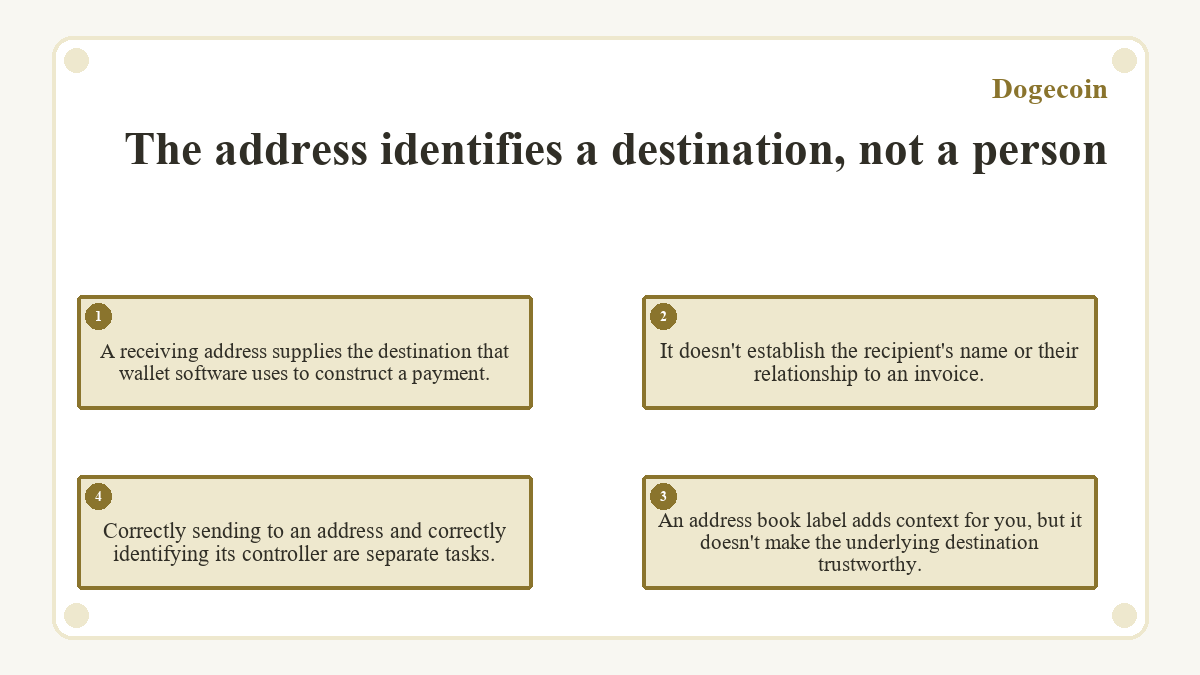
A receiving address supplies the destination that wallet software uses to construct a payment. It doesn't establish the recipient's name or their relationship to an invoice. An address book label adds context for you, but it doesn't make the underlying destination trustworthy. Correctly sending to an address and correctly identifying its controller are separate tasks.
Obtain payment instructions through a channel that you already associate with the recipient. An unexpected replacement address deserves fresh confirmation, especially when the request also urges immediate payment. Confirming a changed address through the same questionable message leaves the original uncertainty unresolved. Neither a familiar logo nor a recognizable display name proves control of the receiving wallet.
What does an address check actually prove?
An address check tests whether the supplied text meets the wallet's address rules; it doesn't authenticate the person receiving your payment. Dogecoin address decoding checks an embedded checksum to detect encoding errors. That check can catch a copying mistake, but another person's correctly formed address can also pass. Treat successful validation as permission to continue reviewing the destination, not as proof of ownership.
Checking copied addresses and scanned payment requests
Copying text and scanning a QR code reduce manual typing, but both require a comparison with the intended payment instructions.
Addresses copied from text
Compare the pasted address with the recipient's confirmed version after it enters the wallet. Copying avoids transcription, but selecting the wrong saved entry or copying an unrelated address still produces the wrong destination. Checking only the opening and ending characters leaves the middle unchecked. If the approval screen abbreviates the address, use its supported detail view before approving.
Scanned payment requests
The decoded destination
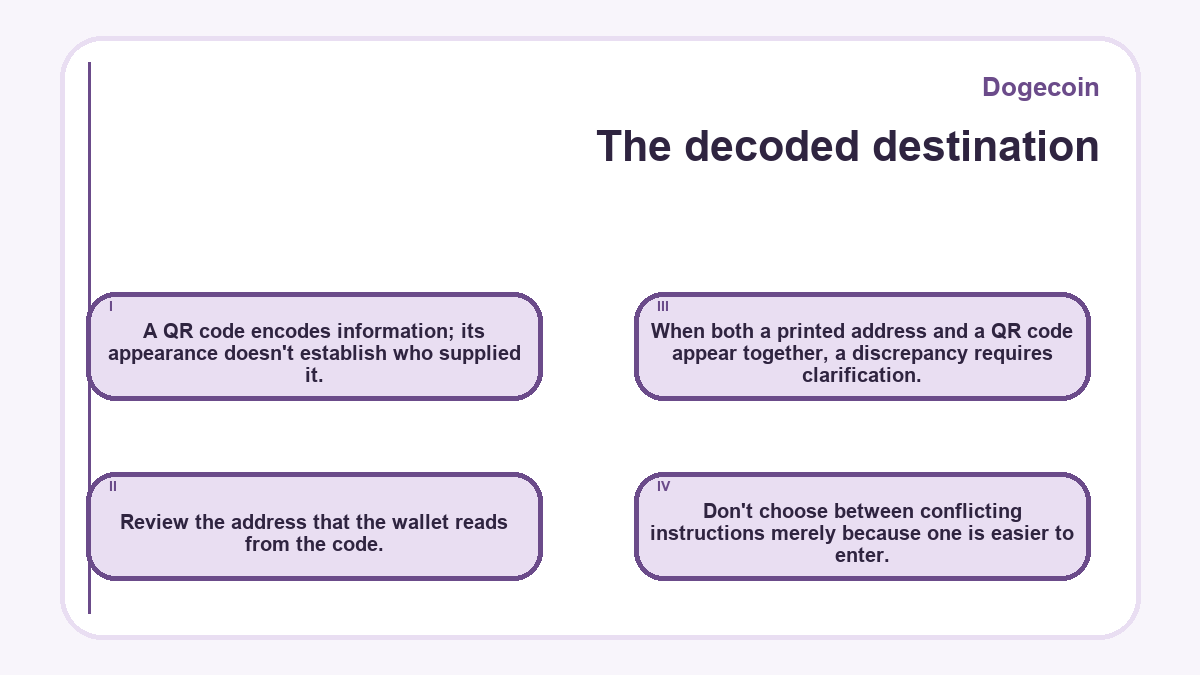
A QR code encodes information; its appearance doesn't establish who supplied it. Review the address that the wallet reads from the code. When both a printed address and a QR code appear together, a discrepancy requires clarification. Don't choose between conflicting instructions merely because one is easier to enter.
The requested amount
A payment request may also supply an amount. Check the value that appears in the wallet against the intended payment, including its displayed unit. Scanning the correct destination doesn't establish that every other field is correct. The final approval should reflect both the right address and the amount you mean to send.
Match the receiving network before approving
The receiving instructions must support native DOGE on the Dogecoin network for an ordinary native transfer. If a sending service presents a network selection, match it with the destination's deposit instructions. A shared ticker doesn't establish compatibility between different networks or asset representations. For a hosted receiving account, also check whether deposits are available and whether the intended amount meets its applicable conditions. Those service conditions can change even though a saved address still passes its format check.
Where does a DOGE payment stop being reversible?
The dependable opportunity to back out ends before you authorize sending or release a signed transaction that someone else can broadcast. Different wallets combine preparation, signing and transmission differently. A button's wording alone doesn't establish whether another confirmation screen will follow. Treat the permission that authorizes sending as the commitment point unless the wallet explicitly separates those operations.
Unsigned drafts
An unsigned draft doesn't contain the spending authorization needed to transfer the coins. You can revise its recipient or discard it before signing. A payment service's submitted withdrawal request differs from a local draft: the service may already have permission to act, even while its interface shows a processing state.
Signed transactions
A fully signed, valid transaction can be submitted to the network without another signature from its sender. Sharing that transaction therefore changes your control over whether it gets broadcast. Closing a wallet doesn't recall copies held elsewhere. After transmission, there is no dependable sender-controlled undo operation; a return payment requires a separate transfer from someone who can spend the received coins.
Read the amount that reaches the recipient
The recipient amount and the total wallet deduction answer different questions during payment approval. The recipient amount describes the intended payment output; the total deduction also accounts for the transaction fee. Some wallets support subtracting that fee from the entered amount, which reduces what reaches the destination. Check the selected behavior before approving. A service may apply its own withdrawal charge, so its displayed net amount also matters. Changing the fee won't correct an incorrect destination.
A pending payment requires a status check
Pending describes an incomplete state, but it doesn't identify which part of the process remains unfinished. A service might still be processing a withdrawal, a broadcast transaction might await block inclusion or a receiving account might await its required confirmations. Identify the actual state before submitting another payment. A second request can create a second transfer if the first one later completes.
A transaction ID helps locate the network transaction, while confirmation information indicates its relationship to the blockchain. Mining provides block inclusion; it doesn't verify that you intended to pay the address in the transaction. If a provider still holds an unbroadcast request, cancellation depends on that provider's available controls. A missing explorer result alone doesn't prove that the request is canceled or that another node lacks the transaction.
Can a test payment confirm the recipient?
A test payment provides useful evidence when the intended recipient confirms receipt in the intended wallet or account. A blockchain entry alone establishes neither that person's identity nor their access to the destination. A test also commits real coins and incurs any applicable charges. Receiving services may impose deposit conditions that make an arbitrarily small transfer unsuitable.
Receipt can confirm that a destination worked for that payment, while a later transfer still needs its own address review. A newly pasted destination can differ, and a service's receiving conditions can change. A successful test doesn't reserve a fee, guarantee future processing or make the next payment reversible.
Saved contacts and fresh receiving addresses
A saved contact reduces repeated entry, while fresh receiving instructions can reflect a recipient's changed wallet or account arrangements. Neither deserves automatic priority when they conflict. Confirm which destination the recipient intends for this payment. An unfamiliar address isn't necessarily wrong, since wallets can manage multiple receiving addresses. Equally, a familiar label doesn't establish that its saved address remains suitable for a hosted deposit. Keep address labels descriptive enough to distinguish their purposes without treating the labels as network-verified identities.
Keep the receipt that identifies the transfer
Retain the transaction ID together with the intended recipient address and the payment amount. These details let you distinguish the actual transfer from another payment with a similar amount. A screenshot of an approval screen records what appeared there; it doesn't independently establish that the network accepted the payment. Preserve the transaction details available after submission as well.
For a hosted recipient, the account's credited deposit provides a separate piece of evidence. The blockchain records the transfer to an address, while the provider decides when its account ledger recognizes that deposit. If the destination differs from the confirmed instructions, preserve both records before seeking help. Troubleshooting shouldn't require disclosing a recovery phrase, private key or complete wallet backup.
Keep the denomination visible in payment records: DOGE.
Details worth knowing about Dogecoin
Are uppercase and lowercase letters interchangeable in a DOGE receiving address?
Uppercase and lowercase letters aren't interchangeable in Dogecoin's Base58 address encoding. Preserve the exact character sequence that the recipient supplies. Changing capitalization can make an address invalid, so don't normalize it like ordinary text. A wallet's format check also doesn't replace comparing the destination with the recipient's confirmed address.
Must the recipient share a private key to receive my payment?
The recipient doesn't need to share a private key to receive DOGE. Their receiving address supplies the destination information for an ordinary transfer. Private keys authorize spending, so requesting one would expose control of their coins. Likewise, you shouldn't supply your own recovery phrase or private key to someone claiming to verify a receiving address.
Will the recipient see the contact label saved in my wallet?
A local address book label doesn't become an on-chain recipient identity. In Dogecoin Core, wallet labels and transaction comments serve local recordkeeping rather than a public payment memo. A hosted service may handle its own messages differently. Don't rely on a private wallet label to communicate an order number or identify the payer to a recipient.
Which address should I provide when someone returns a DOGE payment?
Provide a receiving address that your wallet or receiving service identifies as suitable for the return. Don't assume that an address visible among the original transaction's inputs belongs to your personal receiving account. A hosted sender may have used its own wallet, and automatic returns to that address may require the provider's help to credit correctly.
Is sharing a transaction ID private?
Sharing a transaction ID lets someone look up the associated public transaction details. It doesn't reveal a private key or grant spending access, but it can connect your identity with payment activity. Share it where needed to identify a transfer, while remembering that the recipient can inspect more than the brief receipt shown in your wallet.
How can I distinguish a withdrawal reference from a blockchain transaction ID?
A withdrawal reference identifies a request inside a service, while a blockchain transaction ID identifies a network transaction. The service may display both, or provide the transaction ID after broadcasting. Read the field labels rather than assuming any long identifier is searchable on the blockchain. An internal reference alone doesn't prove broadcast or confirmation.
Does an unused receiving address need an activation payment before it can receive DOGE?
An ordinary Dogecoin receiving address doesn't need a separate activation payment before it can receive coins. Transaction fees apply to spending transactions rather than activating an address. A receiving service may impose its own deposit minimum or account conditions, but those requirements don't establish a network-wide address activation charge.